Germany is currently operating the world biggest permanent storage for dangerous waste UTD Herfa-Neurode. Contains at least 690,000 tons of waste containing dioxins and furans, 220,000 tons of waste containing mercury, 127,000 tons of waste containing cyanide, and 83,000 tons of toxic waste containing arsenic. Nuclear waste is currently excluded, but I think it would not make a difference, especially because after about 400 years most dangerous fission products (Caesium-137, Strontium-90, and Iodine-131) decay away and only Plutonium and minor actinides stays. Mercury, arsenic, dioxins and furans stay forever.
We learned quite lot about underground migration of plutonium over millennia because we studied the remnants of the natural nuclear fission reactor which nature run about approximately 1.7 billion years ago in Oklo, Gabon.
"Plutonium has moved less than ten feet from where it was formed almost two billion years ago contained in the sedimentary rocks that kept them from being dissolved or spread by groundwater."
I would generalise this a little: The problem with buying a complex item is information inequality. The seller knows more about it than the potential buyer. When inspecting the item, the buyer therefore looks for signs of hidden defects or for evidence that the item is in good condition overall. In this way, cleanliness becomes a proxy for the general condition of the object. Similar mechanisms are at work elsewhere too. Take job applications, for example. A sloppy application is a red flag, even if the applicant’s references are excellent.
"Information inequality" is known as "risk". Risk is inherent in any transaction. That factors into the price: one is willing to pay less the more risk there is, and will pay more for less risk.
Most "risks" have an upside and a downside. In this case, for example, the solar PV system may be working better or worse than the (potential) buyer initially comes to understand.
We have huge industries based on selling "risk, but with a huge potential upside" to people willing to pay for access to the potential upside. Many of those customers are not interested in low risk in that context.
So "more risk, pay less" is not a hard and fast rule, but depends on what is being purchased, the circumstances of the buyer, and more.
The Black-Sholes equation is an attempt to calculate risk. Of course, risk is difficult to pin down to a number, and different people will assess risk differently.
But that's irrelevant to my point, which was that risk is factored into the price.
The authors claim that he spent "9,600 euros to start a company" is misleading. Since he wants to reduce his liabiliy and therefore the risk of his customers as much as possible, he opted for a complex solution that involved founding two joined companies.
In addition, he counted 2,000 € of shared capital as an expense, which it isn't. He did not opt for a "cheap" UG which requires no up-front capital, because of its bad reputation.
He also includes a bill for accounting software of 426.97 € into his calculation. This has nothing to do with founding costs, but are operational expenses.
As the author states that he set up the company through a law firm, I wonder which of the figures includes the cost of this service. To be fair, this should be listed separately, as such costs can vary widely or be omitted entirely if the company is incorporated solely through a notary.
Also the information about the minimum deposit when founding a GmbH is incomplete. He states: "A GmbH wants 25,000 euros sitting in a bank account before it is allowed to exist." Fact is that you need only deposit half of it upfront into the GmbH; you only have to deposit the rest of the money if the company is in trouble. The company can also immediately lend the deposit back to the founder at market rates. If the company’s articles of association permit it to hold shares in other companies, the company may also use the contributions to purchase shares or similar financial investments. His law firm should actually have advised him on this matter.
The main differences between a standard GmbH and a GmbH & Co KG lie in their somewhat different tax arrangements.
So all in all, the author paid 7,227.74 € to found a rather complex company structure. Judging by his reasoning, presumably for the wrong reasons.
When I found a GmbH in 2019 without the help of a law firm, it cost me about 2,000 euros (if I recall it correctly).
I founded a UG in december for 250€ (beglaubigt.de) + 180€ (notary but w/ Mustervertrag) + 150€ (round about, not a 100% sure, Handelsregister) and 35€ Gewerbeanmeldung (which isn't even tied to founding the company itself relly). Still waiting for my UStID tho. supposedly exists since january, but they aren't able to deliver the letter or tell me on the phone ...
The notary system is pure scam and should be abolished. They literally just read your documents, stamp, sign. It’s expansive, outdated and doesn’t bring any value
The pro-nuclear propaganda in this discussion reminds me of the tobacco companies that claimed smoking was harmless, or of Monsanto, which insisted that its pesticides were safe, and so on. It is always the same pattern: obvious facts are denied, doubts are exaggerated, legitimate concerns are downplayed, and blatant lies are spread. I wonder how many undercover lobbyists for the nuclear industry are active here on HN.
Fascinating how ppl mention pro nuclear propaganda when we already know the facts. France and Sweden have among the lowest emissions in EU and got them in 90's by building both ren and nuclear. Germany built only ren, DK built only ren and both have far worse emissions.
> And to the haters: Show me any company or product from Germany in IT that is Top 100 globally.
Also I wouldn’t want to disagree with you outright, there are still a few important German companies in the IT sector (or related): Siemens, Infineon, Deutsche Telekom, Bechtle, TeamViewer come to my mind.
What Siemens exemplifies is that the strength of German industry is not pure software, but high-tech machinery. While Siemens and most of its spin-offs are doing somewhat okay, the stocks of its spin-off Siemens Energy have risen by ~700 % in the last 3 years.
Where Siemens really shines, is in their fanatical devotion to after sales.
I rely on Siemens automation products at work. They give me end-of-life warnings a couple of years ahead - and maintain a spares inventory for a decade and change after EoL.
That basically ensures I am never caught out, and makes me more than happy to (grudgingly) accept all their ideosyncracies...
I assume it makes you a loyal customer when upgrading/replacing equipment too... knowing what to expect and that you're going to have all of that support.
So many product companies fail to think about that -- they're all thinking about this quarter and very few take a long term approach and really try to have customers for life. They all say that want that of course, but too few are really committed to it. There are a few brands that I buy that are committed to quality, and they usually cost more (initially, but probably not in the long run). I'm fine paying more know that they really tried to do their best and didn't let nickels and dimes get in the way of an otherwise great concept.
Of course; I will jump through just about any hoop in order to keep buying their products precisely as I know that will buy both me and the end customer long term peace of mind.
Industrial automation as a market is like that. Those products are expected to be long lived and supported for decades because the machinery they are attached to often has a similarly long lifespan. A company I worked at was still supporting 20 to 30 products and in some cases building new hardware from 30 year old designs (including the exact same electronics).
>a few important German companies in the IT sector (or related): Siemens, Infineon, Deutsche Telekom, Bechtle, TeamViewer come to my mind.
None of them famous or being praised by customers for having amazing UI/UX though, because they're not consumer products, they're targeting engineers who either don't care about UX, or don't have a choice in the matter because their company is buying it, not them.
Cars on the other hand ARE consumer products and do need great UX, and German companies long forgot how to do that since they operate everything as a cost center and outsource everything they perceive ads no value.
>the strength of German industry is not pure software, but high-tech machinery
Yeah but there's more margins in pure software and more buyers in the world for consumer devices than for high tech machinery. Apple can probably buy all of Germany's machine tool makers if they wanted to. It's the perk of selling to 7 billion consumers in the world.
> the stocks of its spin-off Siemens Energy have risen by ~700 % in the last 3 years.
Just like every energy and defense stock in the world right now, but that's to be expected and somewhat offtopic for SW and UX.
If we look at some of their other consumer and healthcare spin-offs like Gigaset or Healthineers, they are doing insanely poor, which is embarrassing.
They havent totally forgotten. I drove a 2025 BMW last week and noticed many similarities to my favorite car, the '92 325IS. The speedo and tach both aligned in top gear, the thumb hooks were still perfect, and the cluster still dimmed enough for night driving. Someone at BMW remembers how to do UI.
>and outsource everything they perceive ads no value.
In their defense, if they know they have no inhouse competence and their existing org structure is not good for building software, then doesn't it make sense to contract people who do and can?
Also, if Germans admittedly are not great at building good UX, and/or software, there are countries/companies who definitely don't suffer from that shortcoming.
And I'm not sure why German cars suck == Europe is doomed, what about the infotainment on Renaults?
In fact, you can run any form of European legal entity from any country. I.e., I can create an spółka z ograniczoną odpowiedzialnością (sp. z o.o.) in Poland, but run the business in Germany. It would be complicated and stupid, but legal.
You can! A foreign EU company just needs to get a "Betriebsnummer" (company number) from "Bundesagentur für Arbeit", which doesn't even require a Betriebsstätte (permanent business establishment, a branch that is not legally independent) or a "Zweigniederlassung" (branch office, legally semi-independent, but still part of the same entity) - and certainly not a subsidiary that has it's own legal persona.
SAP is basically the core of the German compliance machine. Most of the time, people get onto SAP not because its good, but there's a bunch of compliance regs, which basically say 'use SAP'. Noncompliance results in firms basically not doing business with you.
You could try to be boneheaded and comply with whatever standards they need your own way, but that would mean your business partners would need to do more due diligence and expose themselves to risk of what happens if regulators are not happy with the way you conduct your business. So you use SAP.
Is this based on actual experience? Because at a place I worked in the past we did business with BMW, Allianz, Siemens, Munich Re and others and never had to use SAP. Maybe it depends on what part of the delivery chain you are.
For instance with Munich Re you have to "pass" their compliance gate which is comprehensive but still has a lot of leeway.
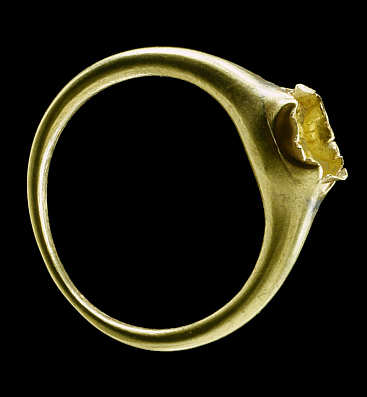
On 9 July 1537, Martin Luther wrote in a letter to Wolfgang Capito about a lost golden ring: "Pro annulo aureo gratias tibi agit mea Catharina, quam vix unquam magis indignatam vidi, quam ubi sensit, cum vel furto sublatum, vel sua negligentia (quod nec mihi verisimile est, licet usque ingerenti) amissum, quod persuaseram ei, hoc donum esse felix omen et augurium ei missum, tanquam nunc certum esset, vestram Ecclesiam cum nostra suaviter concordare; id mire dolet mulieri."[1]
When Luther's house in Wittenberg was excavated about 20 years ago, a golden ring[2] was found that must have been deposited there before 1540. It is therefore quite likely that this is the ring mentioned by Luther in 1537.
My Catherine thanks you for the golden ring, whom I have hardly ever seen more indignant than when she realized that it had been stolen or lost through her own negligence (which is not likely for me, although I still insist on it), which I had persuaded her that this gift was a happy omen and augury sent to her, as if it were now certain that your Church would agree pleasantly with ours; this grieves the woman wonderfully.