Your best bet is to use hooks and inject it after every file edit / response by first running the content through haiku and asking if it is asd 100 ste.
It burns more tokens but is the only way to get tolerable text.
The hook sends the text to another agent/context with a request to validate and return a good or bad + reason response. Every request is a fresh context.
I don’t think system prompts are particularly reliable way to do much at all. It’s better to put it as a hook after each response, or a skill at least so you can trigger it at will if you don’t want it everytime.
Anthropic has probably RL’d the system prompt into nothing because of their fear of the user being able to control the model. If it listened to you about the slop language, it might listen to you if you asked it to help you with no-no tasks.
Oh... amazing. just had a vision of being able to be in a meeting and talk through an User Interface design / review, while in a zoom meeting or whatever.
...i like.
---
- Design system / Component lib
- Live view of what components, tokens, other things... on the left side of the screen.
- You're in the meeting and talking while talking and transcribing and doing the full duplex voice. You say, "Find what tables and customizations we have available" and the list starts to filter to tables and customizations.
- "Let's add that table to the page; left side; 3/4 width of page. Headers should be static for vertical scroll, ..."
- The table is added to the page.
- "Nah, i don't like it. Let's change that table component to have larger headers..."
yes, i like--let's see what Astra Pro pops out with.
The problem with that is that it only works with simple, least interactive UIs. Each new UI a human will be presented needs to be learned to be ised effectively otherwise a user will be lost.
Having said that, imo, Gen UI only makes sens as a presentation layer - not controls. Unless LLM will be using a set of very well defined and homogenic components like table, forms, small widgets.
> The problem with that is that it only works with simple, least interactive UIs.
I believe that's incorrect. you can define the architecture to be able to provide data based on information from the frontend and the components just need to define a query and data structure or something -- will have a prototype soon
I think this actually might be one of the best ways to train people to use AI. I can see this honing people's prompting abilities and expressiveness, along with constraints and desired outcome.
One thing I don’t get with a lot of these agents.md and other skills are… why not throw as much mechanical checks and other stuff at the repo to constrain as you want instead of asking a non-deterministic agent (squishy or non-squishy) to maintain it.
With the mechanical routes, we get checks, failures, and so much more. A bit wild to me.
Make an agent operate within defined constraints and yell at it when it doesn’t.
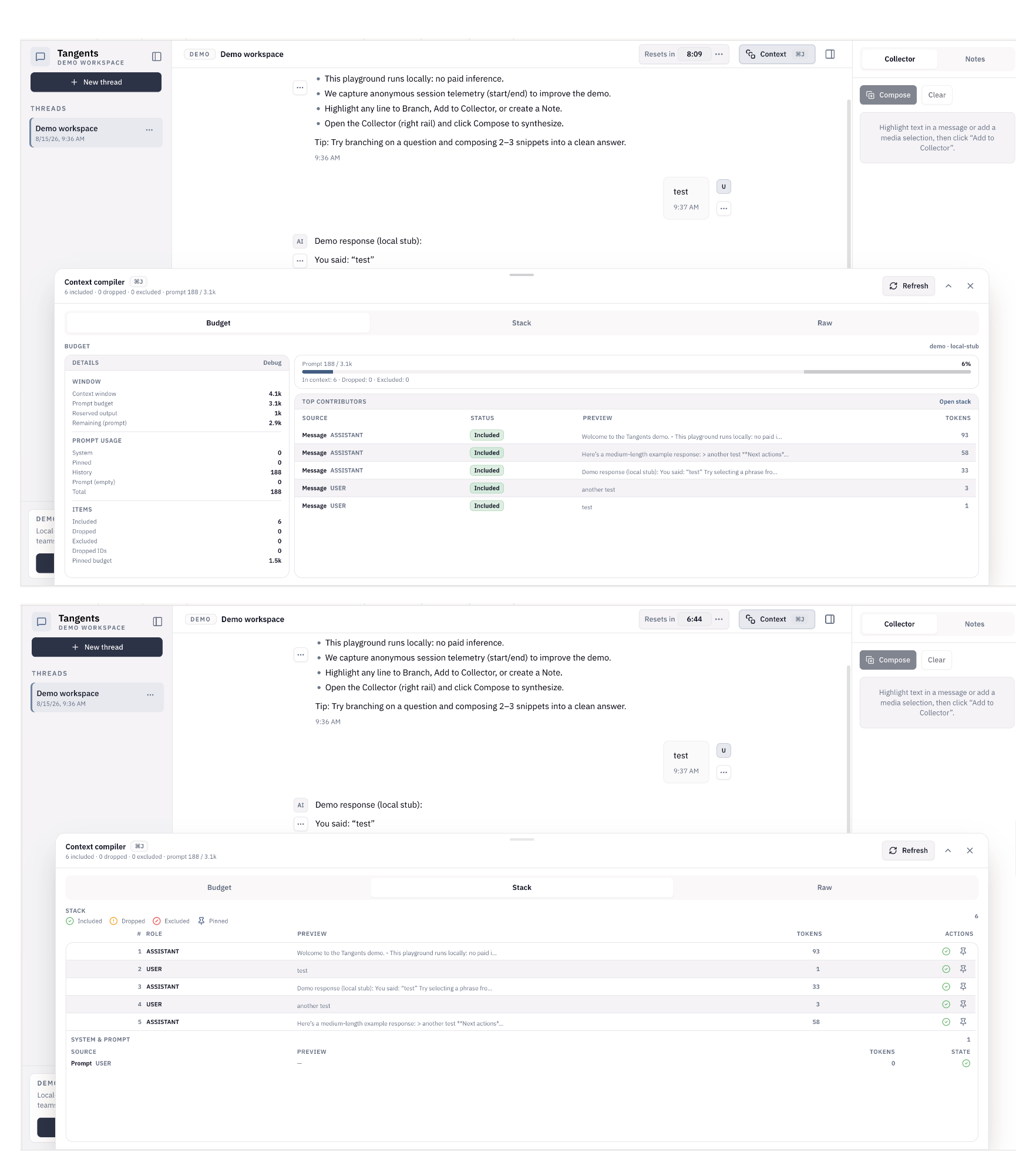
Nice. seems like this converges on something i built called https://Tangents.chat, specifically the "Context complier", which can be seen here (https://tangents.chat/demo) (click Context in the top right after entering the demo).


reply